 By
By Alphanso Kalama
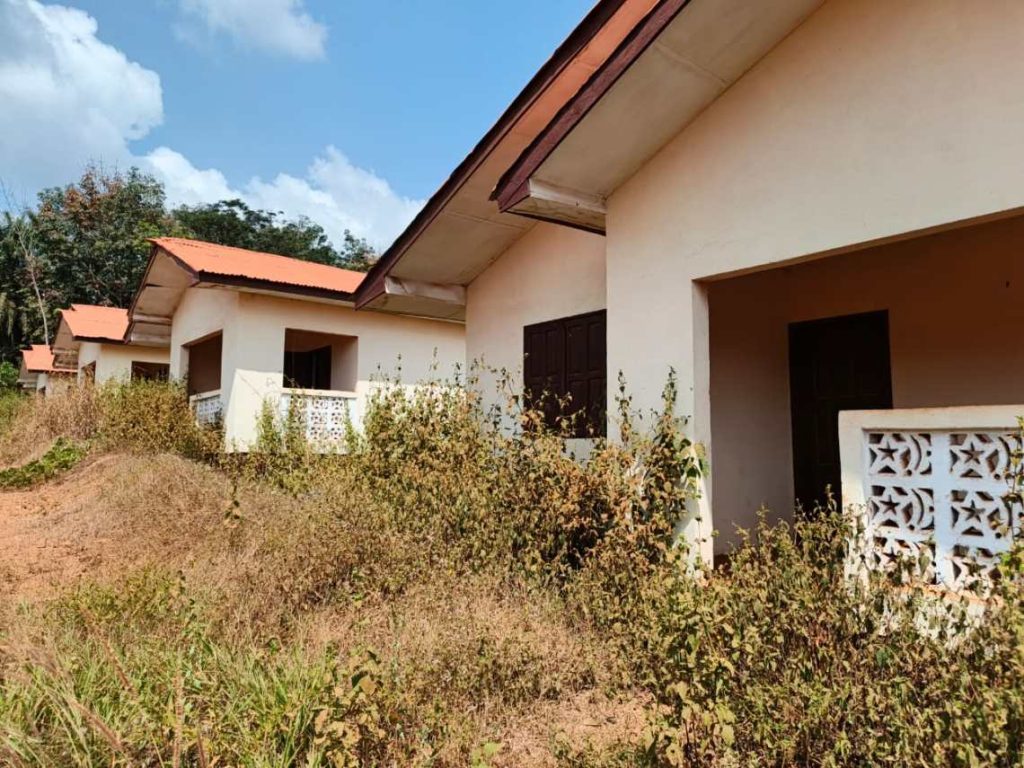
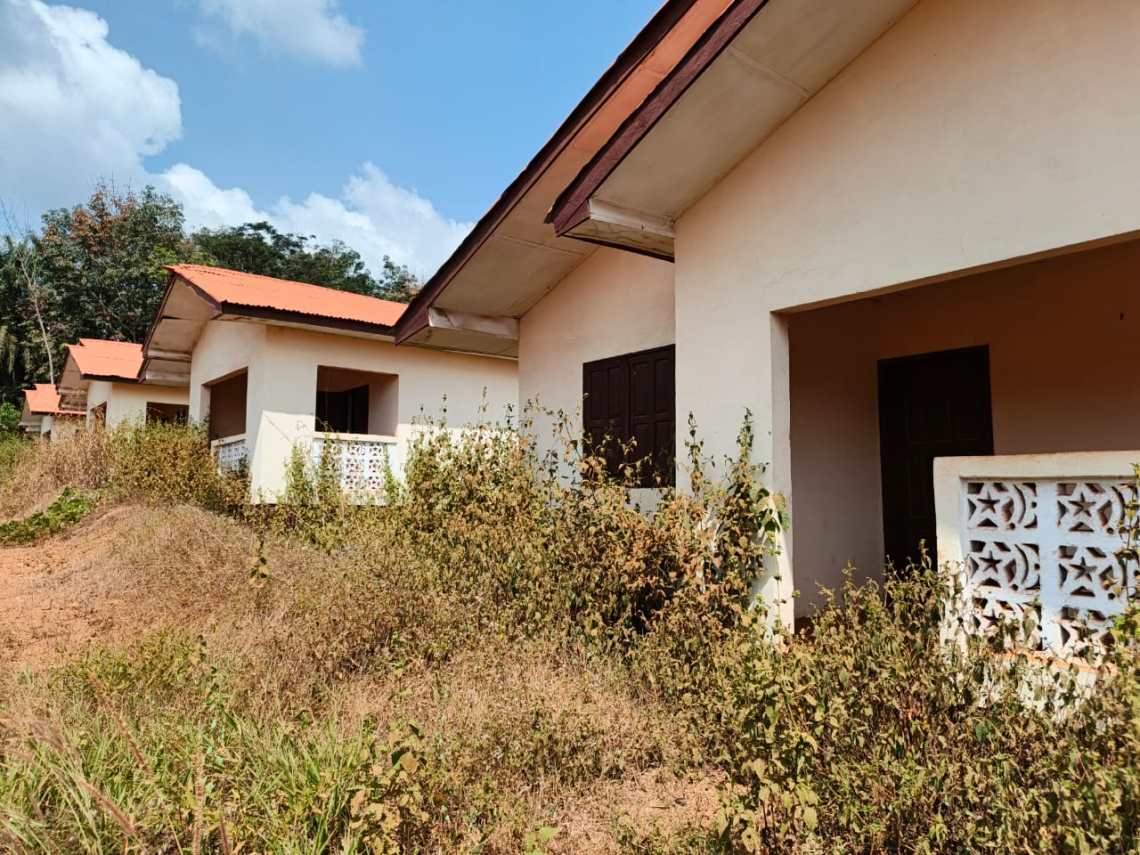
ZORZOR, Lofa County — Far from the noise of Zorzor town, where expectant mothers should have found comfort and care, four concrete structures lie quietly along the Zorzor –Fissebu highway. Birds flutter in and out of window frames, grass climbs toward the roofs, and the only signs of life are the passing vehicles that speed by without stopping.
These buildings, constructed under former President George Manneh Weah’s pro-poor housing initiative, were meant to serve as maternal waiting homes—safe places where pregnant women nearing delivery could stay close to medical help. Instead, the units remain unused, overtaken by vegetation and surrounded by questions.
The maternal waiting homes emerged from promises made during President Weah’s June 2021 county tour of Lofa, when his administration pledged development projects aimed at easing long-standing social and health challenges in rural Liberia. Under the Liberia Agency for Community Empowerment (LACE), ground was broken on July 29, 2022, with officials assuring residents the project would be completed by late 2022 or early 2023.
That deadline passed quietly. Today, a visit to the site reveals buildings that are only about 80 to 85 percent complete. Doors and windows are installed, but there is no electricity, no running water, no septic system, and no sign that the structures were ever formally turned over to the Ministry of Health.
While six housing units were reportedly planned, only two were built within the Curran Lutheran Hospital compound. The remaining four were constructed several kilometers away from the hospital, a distance local authorities now concede undermined the project’s purpose.
“The idea itself was good, but the location defeated the purpose,” Zorzor District Commissioner Paul R. Kalama said. “A pregnant woman cannot stay far from town, go into labor at night, and struggle to reach the hospital. Because of that distance, the women abandoned the place.”
According to Commissioner Kalama, the project was never completed nor officially handed over to health authorities, leaving the district administration with no clear guidance on how the facilities should be used. Key installations remain undone, and safety concerns persist due to the buildings’ proximity to the highway and ongoing road construction.
At the Curran Lutheran Hospital, the silence surrounding the project is equally striking. Hospital Administrator Sumo Woyea told Journalists that the hospital was never formally informed that the highway structures were intended to be maternal waiting homes.
“We only heard it as a rumor from the community,” Woyea said. “There was no official communication to my knowledge—nothing from the district health team or the authorities.”
Woyea clarified that two units constructed within the hospital compound were not maternal waiting homes but staff quarters requested by the hospital due to accommodation shortages. Those units, he said, were later completed by the hospital itself and are now in use.
On whether the hospital could manage a maternal waiting home located far from the facility, Woyea was cautious. He said any decision would depend on formal handover, protocol, and clarity from the Ministry of Health. Until then, he stressed, the project remains unofficial in the eyes of the hospital.
The District Health Team shares similar concerns. Michael Ude, a District Health Official in Zorzor, said the health team was never consulted during the planning or construction of the maternal waiting homes.
“We only became aware after construction,” Ude said, describing the site as bushy, unused, and unsuitable for maternal care. “For a maternal waiting home, there are requirements—midwives, emergency access, proximity to a health facility. That place is not near any health facility.”
Ude said discussions are ongoing to possibly repurpose the structures for office space or staff residence, pending approval from county and district authorities. However, he emphasized that using the buildings for maternal care in their current state is not feasible.
Former Zorzor Mayor Garmai Gbelee, who served during the Weah administration, confirmed that the site was selected by the former district authority through engagement with customary landowners. She said the project was intended mainly for pregnant women traveling from communities outside Zorzor, including Fissebu, Zelemai, and Zuozi.
Gbelee acknowledged limited involvement in land decisions, explaining that she had little knowledge of government-owned land within the city at the time. Still, she argued that the distance alone should not automatically disqualify the facility.
“With electricity, water, and an assigned ambulance, people can stay there comfortably,” she said.
Former District Commissioner Joseph Bedell, who oversaw the district during the project’s initiation, said the location was deliberately chosen based on a broader vision. He explained that former LACE Executive Director Pepci Yeke proposed placing the maternal waiting homes along the highway in anticipation of a future “common hospital” to be built between Fissebu and Zorzor.
“That was the idea,” Bedell said. “The thinking was that when a common hospital is built there, the maternal waiting home would already be in place.”
Bedell said he does not know the total cost of the project and was never provided with financial details. He added that land for the project was made available by residents of Yeala and surrounding communities.
Today, no common hospital exists at the site. What remains are silent buildings—caught between an unrealized vision and immediate reality.
For residents of Zorzor, the maternal waiting homes stand as a visible reminder that development projects, when poorly coordinated and distantly placed, can drift away from the very people they are meant to serve—leaving concrete behind, but care still out of reach.