 By
By By: Staff Writer
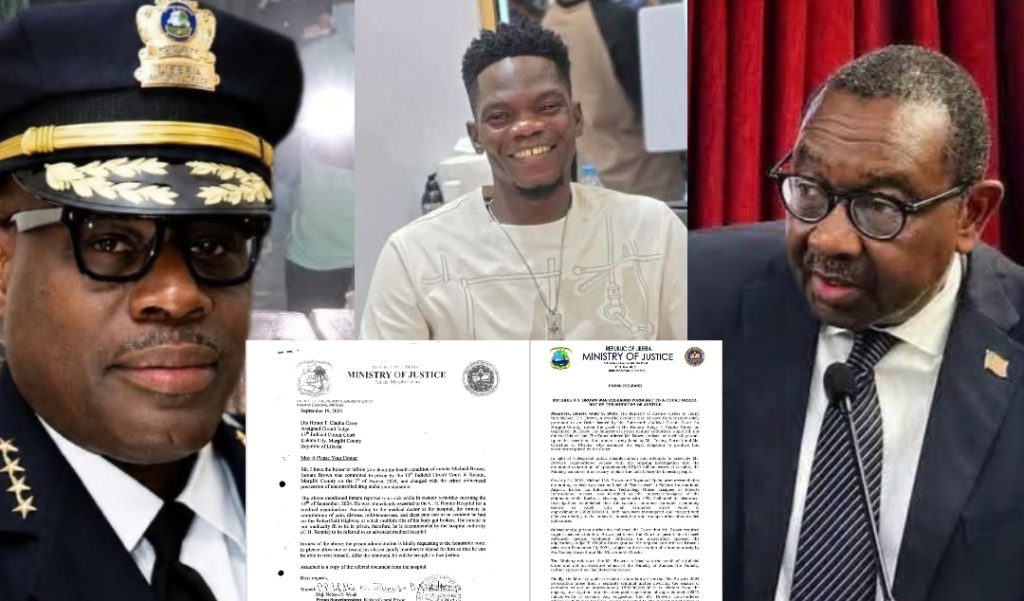
Monrovia, Liberia — Two years after Michael U.S. Brown walked out of Kakata Central Prison on a “medical release,” Liberia’s Ministry of Justice has offered no credible explanation for why a man charged with a non-bailable drug offense remains free, nor why he has not been questioned in connection with the June 8, 2026 seizure of 237.6kg of cocaine valued at US$19.2 million. The Ministry insists it merely executed a court order, but Senate investigators and a growing chorus of civil society voices are asking a far more troubling question: Was Brown deliberately released in 2024 so he could continue trafficking operations while the MoJ and Liberia National Police looked the other way? With his name now clearly linked to one of the largest cocaine bust in Liberian history, the refusal of state security agencies to interrogate him suggests either gross incompetence or active protection, and the public is demanding to know which.
The paper trail reveals a process that flagrantly circumvented Liberia’s Controlled Drugs and Substances Act of 2023, which classifies drug trafficking as a first-degree, non-bailable felony. On September 19, 2024, Kakata Central Prison Superintendent Maj. Nelson P. Woah wrote to Judge T. Clapha Carey, claiming Brown had suffered “broken ribs” and required advanced care. The very next day, Brown was released on a “human surety bond” signed by relatives, yet no formal bail ruling ever appeared on the record. Nearly two years later, the sureties—Toshey Garnett and Christine G. Cheeks, have not been compelled to produce him, and no documentation confirms Brown ever returned to prison after treatment. For a non-bailable offense, the absence of any enforcement mechanism raises an undeniable question: Was the surety bond a deliberate sham designed to grant Brown de facto freedom while maintaining the fiction of judicial oversight?
The Ministry of Justice’s defense has only deepened public suspicion. In a July 3, 2026 press release, the MoJ claimed Brown’s release was “solely pursuant to a court order” and stressed it “neither authorized, approved, nor directed” the decision. But if the Ministry truly believes Brown is a person of interest in the 2026 cocaine probe, as his prior conviction and pending indictment clearly suggest, why has it not demanded his immediate return to custody? Why has it not compelled the sureties to honor their bond? And why did the acting Justice Ministry representative admit to senators on July 1 that she had “little knowledge” of the case? These are not mere administrative gaps; they are signs of a system either willfully blind or complicit in shielding a major trafficker. The MoJ cannot claim ignorance while simultaneously insisting it has followed procedure, the two positions are irreconcilable.
The LNP’s conduct is equally damning. Any professional investigator, faced with a US$19.2 million cocaine seizure, would immediately seek to interview individuals with known drug trafficking histories, especially someone like Brown, whose name has resurfaced in direct connection to the GLS-Menzies bust. Yet the LNP Inspector General reportedly downplayed questions about Brown during the Senate hearing, offering no explanation for why the country’s most obvious person of interest has not been called for questioning. This raises a chilling possibility: Are the MoJ and LNP actively protecting the true cartel behind Liberia’s drug trade? By refusing to pursue Brown, by failing to enforce a non-bailable warrant, and by offering vague, contradictory statements, state security agencies are sending a clear message that powerful individuals can operate above the law, and that Liberia’s drug enforcement regime is a paper tiger.
The Senate hearing convened by Senators Edwin Melvin Snowe Jr. and Amara M. Konneh has exposed these failures, but legislative inquiry alone cannot overcome the deep rot that appears to have taken hold. Civil society groups are now insisting that independent international investigators be brought in to conduct a transparent, impartial probe, free from the influence of local officials who may have compromised the 2024 case. Without such external oversight, the MoJ and LNP will almost certainly allow the true cartel to remain intact, protecting their interests while offering a handful of low-level arrests as cover. The Senate must demand that Brown be located immediately, that the sureties be held accountable, and that every official involved in his release, from the prison superintendent to the Ministry’s highest ranks, be questioned under oath. Liberia’s non-bailable drug law means nothing if those who enforce it are the very ones creating the loopholes